Related information
 Related topics
Set up a drop-ship workflow
Drop ship is a workflow that lets you ship orders directly from a vendor to your customer, potentially saving you inventory costs. This topic shows you how to set up this feature to work in your company.
The following sections outline the steps for setting up the drop-ship workflow.
| Subscription |
|
|---|---|
| Regional availability |
All regions |
| User type | Business user with Admin privileges |
1. Create or identify transaction definitions
- You can map multiple sales transactions to the same purchasing transaction.
- You can map a sales transaction to only one purchasing transaction.
-
- For multi-entity, shared companies: If you are setting up the transaction definition mapping relationships at the top level, you can only map transaction definitions that were created at the top level. If you are setting up mapping relationships at the entity level, you can only map transaction definitions that were created at the entity level.
| Transaction Definition | Requirements |
|---|---|
| Order Entry |
|
| Purchasing |
|
2. Configure Purchasing
The option for deliver-to contact at the line level must be enabled on the Configure Purchasing page before buy to order can be enabled.
-
Go to Purchasing > Setup > Configuration.
- In the Enable functionality section, select Enable deliver-to contact at the header level.
Two fields appear.
- Use the Deliver to dropdown menu to select default deliver-to contactWhen creating your deliver-to contacts, give them a name that makes them easy to find in the Buy-to-order deliver to dropdown list, which lists all your contacts. For example, prefix the name with "Deliver to" or "BTO".
- Select Enable deliver-to contact at the line level
- Select Save.
3. Configure Order Entry
You will do the following in the Configure Order Entry page:
- Enable drop ship
- Define the Order Entry transaction definition relationships to Purchasing transactions
- Enable the vendor dimension
-
Go to Order Entry > Setup > Configuration.
- In the Drop ship subsection of the Enable functionality section, select Enable drop ship.
A mapping table appears.
- In the Sales transaction definition column, use the dropdown list to select a sales transaction definition that you created or identified in 1. Create or identify transaction definitions.
- In the Purchasing transaction definition column, use the dropdown list to select the purchase transaction that will be created from the corresponding sales transaction.
- Leave the Active checkbox selected to activate the mapping or deselect the checkbox to make the mapping inactive. For example, you might want to leave a mapping inactive while you complete the configuration.
- Repeat steps 3-5 for each desired transaction definition relationship.
- In the Dimension setup section, select the Vendor checkbox and then select Save.
If you do not see the vendor dimension in this section, enable the vendor dimension in the General Ledger and then try enabling the vendor dimension in Order Entry.To enable the vendor dimension in the General Ledger:
Go to General Ledger > Setup > Configuration.
- In the Dimension settings section, select Enable next to Vendor and then select Save.
4. Update items
Each item that you want to drop ship needs to be updated to set the Available for drop ship option to true. After Order Entry is configured for drop ship, the Available for drop ship checkbox appears in the Item information page for items where the item type is inventory or non-inventory.
The following procedure assumes that the items exist in your system. If the items do not exist, create the items before proceeding.
-
Go to Order Entry > All > Items.
- In the Items list, find the item and select Edit next to it.
-
- Repeat steps 2-3 for each applicable item.
5. Update AP terms for vendors
The system uses the AP term to populate the payment Date due in the purchasing transaction, counting forward the applicable number of days from the sales Transaction date. Each vendor for whom you want to be able to create purchase transactions from a sales transaction should have a default AP term associated with it.
If the system does not find an AP term for a selected vendor, it uses the default AP term from the applicable purchasing transaction definition. If the purchasing transaction definition does not have a default AP term associated with it, the system will throw an error and the user won't be able to save the sales transaction that is initiating the purchasing transaction.
-
Go to Purchasing > All > Vendors.
- In the Vendors list, find the vendor and select Edit next to it.
- In the Vendor Information page, select the Payment information tab, use the dropdown to select the Term, and select Save. Repeat steps 2-3 for each applicable vendor.
6. Update Purchasing price lists
A drop-ship item must have a price defined in a Purchasing price list for the system to create the purchase order from the sales order with purchase prices that aren't a zero amount. The Purchasing price list must be associated with either the Purchasing drop-ship transaction definition or with the selected vendor. The best practice is to associate a default Purchasing price list with the Purchasing drop-ship transaction definition. If the system finds a price list on the selected vendor, the vendor price list takes precedence over the default price list.
-
Go to Purchasing > Setup > Price > Lists.
-
On the Purchasing price lists page select Details next to the applicable price list.
-
Select Add.
- Use the dropdown list to select the desired Item, then complete the rest of the fields as applicable. See Price list entries for information on these fields.
- Select Save.
- Repeat steps 3-5 for each applicable item.
Optional customizations
- Enable the customer dimension in Purchasing
- Customize the sales transaction form layout
-
-
To allow for more complete reporting, Intacct recommends that you enable the customer dimension in the Purchasing application. When the system creates the purchasing transaction from the sales transaction, it populates the customer dimension on the purchasing transaction with the customer name from the sales transaction.
To enable the customer dimension in Purchasing:
Go to General Ledger > Setup > Configuration.
- In the Dimension settings section, select Enable next to Customer and then select Save.
To help your users remember to add a vendor dimension to a line item that they want to drop ship, you might want to change the Entries section column layout in the applicable sales transactions so that the Vendor dimension is next to the Drop ship column as in the following example:
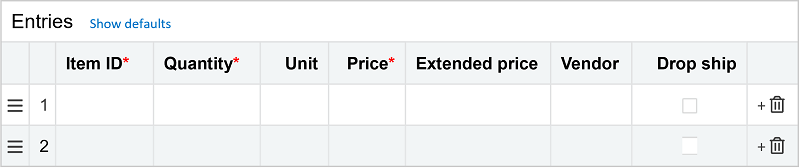
Learn how to move entry fields.
The customer Ship to address from the sales transaction appears as the Return to address in the purchasing transaction. You may want to create a document template that includes the text "Ship to" and place it next to the customer address. You can also add boilerplate comments or special instructions to the document template. Then associate the document template with the applicable drop-ship purchasing transaction definitions.
If your company is subscribed to Customization Services or Platform Services, you can use the Drop-ship History custom report object to create reports about your drop-ship transactions. You can create reports that help you identify drop-ship transactions, compare sales price to purchase price, and so on.
In the custom report writer, select the Drop-ship History object as the primary data source in Step 1. Then select the desired columns, select the column sequence, and so on.
Learn how to create custom reports.
Turn off drop ship
If you enable drop ship and use it for at least one transaction, you cannot disable it. However, you can deactivate the transaction definition mapping relationships. This removes the Drop ship field from the sales transactions so that users cannot create purchase transactions from sales transactions.
Deactivate transaction definition mapping relationships
-
Go to Order Entry > Setup > Configuration.
- In the Drop ship subsection of the Enable functionality section, deselect the Active checkbox in each applicable row of the drop-ship transaction definition mapping table.
- Select Save.
